
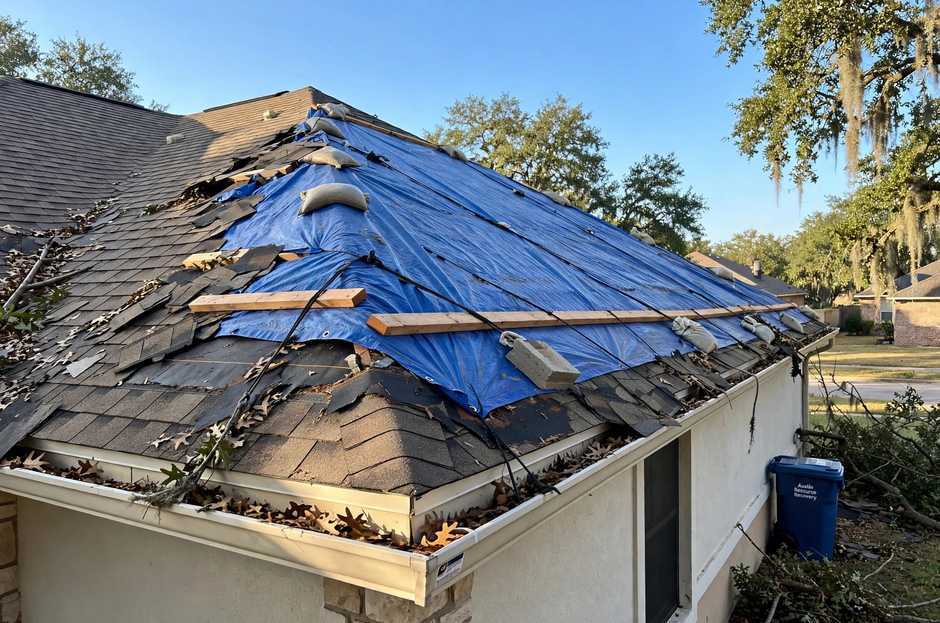
The two forces are heat and storms: heat and UV age shingles steadily, and hail season — March to May — does its damage in bursts. Maintenance has to answer both.
A free inspection is the starting point: call (469) 779-9940, open 24 hours, every day, and we will put the roof's condition in writing.
Why Austin's Climate Is Hard on Roofs
Austin is a hot-humid climate, and shingle life here runs about 18 to 22 years rather than the 25 to 30 years quoted nationally. Heat cracks pipe boots, dries sealant and opens flashing joints — slowly, and then all at once in a downpour.
The hail sequence of September 2023, May 2024 and May 2025 showed the other half of the story: a roof can lose years of life in one afternoon, and the damage is often invisible from the ground.
Austin's dated hail sequence — 24 September 2023, with hail up to 4.0 inches and about $600 million in losses across Travis and Williamson counties; 9 May 2024; and 28 May 2025, with golf-ball hail — has hit every neighbourhood on this site.
Austin builds under the 2024 code family, effective 10 July 2025. A like-for-like residential re-roof is generally permit-exempt, unless the property is in a Wildland-Urban Interface zone and at least half the roofing is replaced, more than 128 square feet of decking is replaced, or the work is structural, commercial or in a floodplain.
Your Austin Roof Maintenance Schedule by Season
Spring: inspect after the first hail event, clear gutters and valleys of oak debris, and check pipe boots and flashing. Summer: check attic ventilation and look for curling, cracking and granule loss. Fall: clear leaves from gutters and valleys and plan major work before winter. Winter: check for leaks before the first freeze.
Late Winter (February): Pre-Storm Season Prep
That is the whole schedule: four checks a year, each tied to what the season actually does to a roof.
- Clear gutters and downspouts of winter debris so spring rain has somewhere to go.
- Check that all shingles are sealed down - lifted tabs catch wind and peel back.
- Look at the flashing around chimneys, skylights, and vent pipes for cracked sealant.
- Trim tree limbs back at least 6 feet from the roof surface.
Austin is a hot-humid climate, and shingle life here runs about 18 to 22 years rather than the 25 to 30 years quoted nationally, with heat and UV doing steady work between storms.
Spring (March-May): Storm Season Monitoring
Oak wilt discipline matters on any Austin roof with trees nearby: do not prune oaks from 1 February to 30 June, and never treat the City's oak-wilt heat map as complete — Shady Hollow has had a serious problem for years yet shows as a small blip on it, and Steiner Ranch does not appear on it at all.
The I-35 soil line is the most useful single map in Austin roofing: east of I-35 sits Houston Black expansive clay, which swells and shrinks with moisture, while west of I-35 the soils are thin limestone, where slope and drainage lead the story.
Summer (June-September): Heat and Ventilation
Never state a specific property's flood status from a website: check ATXFloodPro for the address itself, and remember the City now regulates on the 500-year floodplain.
The most common Austin leak source is a failed pipe boot — UV and heat crack the rubber in about ten to fifteen years — followed by flashing, valleys and skylights.
Fall (October-November): Repair Window
Class 4 impact-resistant shingles are the best asphalt option for Austin hail, but never publish a fixed insurance discount for them: each carrier sets its own.
Texas has no state roofing licence, and there is no state general-contractor licence either. Before hiring anyone, ask about contractor registration with the City of Austin, ask for references, and get the scope in writing.
What to Check After Every Storm
After every storm, look for missing or lifted shingles, granules in the gutters, dented gutters and downspouts, and new stains on ceilings. Photograph anything you find — your insurer will want the record, and granule loss is easiest to prove on the day it happens.
If water is actively entering the home, call (469) 779-9940 now. We are open 24 hours, every day.
- Granules in the gutters and at downspout outlets. A handful after a storm is normal. A steady stream means the shingles are losing their protective surface.
- Dented gutters, downspouts, and vent caps. If the soft metal is dented, the shingles took a hit too.
- Lifted or missing shingles on slopes and ridges. Wind gets under a tab and peels it back. Once one goes, the ones around it are next.
- Water stains on ceilings and exterior walls. By the time you see a stain inside, water has been getting in for a while.
Texas law bars a roofer from waiving or absorbing a policyholder's out-of-pocket share of an insurance claim, and we do not offer that. A roofing contractor also may not adjust a claim on work it performs; what we do is meet the adjuster on site, document the damage and prepare the scope.
How Do I Maintain My Roof in Austin TX Heat?
In Austin heat, the maintenance jobs that matter are ventilation, pipe boots and sealant: balanced intake and exhaust keep the attic from cooking the shingles from below, and a cracked pipe boot is the most common Austin leak source — UV and heat crack the rubber in about ten to fifteen years.
Do not prune oaks to clear a roof without the oak-wilt window: do not prune from 1 February to 30 June.
- Ventilation. Balanced intake and exhaust ventilation keeps the deck from baking. This is the single highest-impact maintenance item for Austin roofs.
- Reflective coatings on flat roofs. If you have a low-slope or flat section, a reflective roof coatings austin TX application can drop surface temperature by 30 to 50 degrees and extend the membrane's life by years.
- Sealant checks. Every penetration - vents, pipes, skylights, chimney - has sealant that dries out and cracks in the heat. Check them each spring and fall.
Austin's energy code requires a radiant barrier in residential roof assemblies, with limited exceptions, and ventilation and insulation work together: a hot attic ages shingles from below as surely as the sun ages them from above.
Common Mistakes That Cost Austin Homeowners Money
No price is published here, because a roof is priced per roof: size, pitch, material, decking, flashing and drainage all change the figure, and a number given for a roof nobody has inspected would be a guess.
What a free inspection does is turn those variables into a written estimate for your own roof: the inspector measures the roof, checks the decking and flashing, and notes what is age, what is storm damage and what can wait.
- Waiting for a leak to call someone.
- Pressure-washing the roof. It strips granules and voids shingle warranties. Don't let anyone do this to your roof.
- Skipping the pre-storm inspection. The best time to find a lifted shingle is before the hail hits, not after.
- Hiring the first storm chaser who knocks. After every big hail event, out-of-town crews show up. Ask for a local address and proof of City of Austin contractor registration.
- Replacing a roof that could be repaired. Not every damaged roof needs replacement. Get a real assessment before you sign anything.
Austin builds under the 2024 code family, effective 10 July 2025, and a like-for-like residential re-roof is generally permit-exempt — unless the property is in a Wildland-Urban Interface zone and at least half the roofing is replaced, more than 128 square feet of decking is replaced, or the work is structural, commercial or in a floodplain.
When to Call a Professional
Call (469) 779-9940 when water is actively entering your home, when a storm has passed and you want the damage documented, or when a stain, a missing shingle or granule loss tells you the roof needs eyes on it. We are open 24 hours, every day, and the inspection and the written estimate are free.
March to May is hail season in Austin: more than three quarters of the city's hail reports fall in those three months, so a spring inspection after the first big storm is the most useful habit a homeowner here can build.
A like-for-like residential re-roof in Austin is generally permit-exempt, but the exceptions matter: Wildland-Urban Interface work replacing half or more of the roofing, more than 128 square feet of decking, structural work, commercial work and floodplain work all need a permit.
Frequently Asked Questions
How do I maintain my roof in Austin TX heat?
Call (469) 779-9940 for a free inspection and a free written estimate — we are open 24 hours, every day.
What roof maintenance is needed before storm season in Austin Texas?
The answer for your own roof comes from a free inspection: call (469) 779-9940, open 24 hours, every day.
How often should I maintain my roof in Austin TX?
Ask about it in a free inspection — call (469) 779-9940 any time, open 24 hours, every day, and the written estimate is free.
Who offers roof maintenance in Austin Texas?
A free inspection reports what the actual roof needs, in writing. Call (469) 779-9940 — open 24 hours, every day.
How much does roof maintenance cost in Austin?
Roofing costs depend on roof size, pitch, material, decking, flashing and drainage, so no price is published here. A free inspection turns those variables into a written estimate for your own roof.
Get Help With Roofing in Austin
Call (469) 779-9940 any time — we are open 24 hours, every day — for a free inspection and a free written estimate. Whether you need an inspection, a repair or a replacement, the first step is a free inspection of the actual roof, with the findings in writing. Related reading: our Roof Maintenance and Roof Inspections pages, and roofing in Northwest Hills and Windsor Park.